
By Dana R. Bennett
Nevada’s slogan – Battle Born – reflects its origin during a national conflict. In 1864, when this sparsely populated territory composed mostly of the Great Basin was formally established as a state, the nation was engaged in a civil war. The primary reason for granting statehood was to provide another electoral vote for President Abraham Lincoln, but it was also helpful that Nevada’s Comstock Lode was producing millions of dollars in silver and gold. Indeed, the opportunity to create this new state would not have existed without mining. By 1864, there were nearly 70 mining districts and countless prospectors across the entire state.
Within two years of statehood, another 25 districts had been organized. Some of these earliest districts, such as Eureka, White Pine (Robinson), and Battle Mountain, continue to yield ore in the 21st century. While dominated by the Comstock Lode, Nevada was producing 28 percent of the nation’s gold and silver in 1864. Nevada’s minerals and the statehood they facilitated were important contributions to the North during the Civil War and contributed to the preservation of these United States.
The turn into the 20th century brought an escalation in industrial innovations and development, all of which required minerals and metals that had not been previously utilized. The growing demand for electricity and electrical devices drove the increasing demand for minerals and metals, too. Nevada geology and geography were still yielding metals and minerals that benefited the country, but by the 1910s, the demand was greatly exceeding the supply, and the U.S. began importing many critical elements from other parts of the globe.
When global warfare broke out in the 20th century, most notably during World War I (1914-1918) and World War II (1939-1945), Nevada’s metals and minerals served the U.S. in two ways. One, they replaced imports from regions that were disconnected by the war’s impact, especially on modes of transportation. Two, Nevada’s mineral storehouses could feed the domestic manufacturing of new weapons and equipment.
During World War I, Nevada’s mineral industry was accelerated by rising demands and rising prices. It was suddenly viable to mine and process metals and minerals that could not be mined profitably before the war. Nevada mines increased their production of antimony, arsenic, copper, lead, silver, cinnabar/mercury, manganese, molybdenum, potash, tungsten, and zinc.
Some of these elements were mined for the first time. The state’s first-ever production of vanadium came from Clark County during WWI. Clark County was also producing most of the state’s manganese. Before the war, the U.S. was importing most of its antimony, but the reduction in imports drove additional production in Nevada, especially from the Sutherland Mine in Pershing County. (The area was still part of Humboldt County; Pershing was not created until 1919 and named for General John J. Pershing, America’s military leader during the Great War.) The Sutherland Mine produced more antimony than any other mine in Nevada or the country at the time.
Between 1915 and 1918, Nevada produced five percent of the nation’s copper and fifteen percent of the nation’s bullion, mostly due to silver production.
Nevada’s mining industry continued to produce into the 1920s until imports returned to pre-war levels. The production of some elements, such as antimony and tungsten, stopped completely, but others, such as copper and arsenic, maintained their momentum. In the early 1920s, due to a rising demand for insecticides, Nevada was the second largest producer of arsenic in the country.
As hostilities increased in Europe during the late 1930s, Nevada mining, once again, picked up the pace. Antimony production re-started; by 1942, 11 mines were in operation. Tungsten and manganese production resumed. Nevada Tungsten’s greatest period of production was 1941 to 1956. The price of mercury rose at the beginning of World War II and stayed high through the 1950s. Nevada mines produced an annual average of 6,000 flasks, less than during World War I, but still significant. Mercury production is no longer legal in the United States.
On the other hand, the demands of World War II also harmed an important part of Nevada’s mining industry. In 1942, the U.S. War Production Board issued L-208, which closed precious metal mines across Nevada and the country. The federal government reasoned that the miners who had not yet been drafted into the military should focus on producing metals and minerals, such as copper and tungsten, that were needed for weapons manufacturing. The order devastated Nevada’s gold mining industry, which did not recover until the development of the Carlin Trend in the mid-1960s.
Despite the reduction in gold production, Nevada was an important part of the nation’s victory in World War II. Nevada Senator Pat McCarran (then-Chairman of the Senate Committee on Judiciary) declared that the country’s mining industry, including Nevada’s, “played a role second-to-none in winning victory during the last war.” In a 1950 letter to President Harry S. Truman, Senator McCarran explained how vulnerable the country was in its reliance on mineral imports. “If submarine warfare cut off foreign sources of these materials, our mines would have to supply them,” McCarran wrote. “Without these metals, we would have no steel industry, no jet engines, no poison gas, no storage batteries, no electric lights, no radio tubes, no guided missiles and no anti-atomic weapons.”
As it turned out, the U.S. was soon embroiled in military engagements in Korea and Vietnam. In essence, the country was at war well into the 1970s. For much of that time, Nevada was an important source of industrial minerals for the country. In the early 1950s, Nevada was among the top four states producing mercury, tungsten, manganese, and copper. Nevada’s iron ore was exported to Japan. The Nevada Bureau of Mines reported that the state’s nonmetallic mineral production had steadily increased through the 20th century, with significant increases during World War II and the Korean War. As of 1962, Nevada’s industrial mineral production included barite, borates, clays, diatomite, fluorspar, gems, gypsum, lime, perlite, salt, sand and gravel, silica, stone, sulfur, and talc.
Some of that increase was driven by federal purchases, however, and not the demands of an open market. During the middle years of the 20th century, the federal government operated and funded a program to purchase and store critical minerals, some of which came from Nevada mines. Nevada mines that existed as a result of federal purchases included those that produced tungsten, manganese, or uranium. The stockpiling program was determined to be unnecessary with the collapse of the Soviet Union in 1991 and dissolved.
From the Civil War through two World Wars, Nevada’s mining industry produced a wide variety of much-needed metals and minerals that helped to defend the country.
SOURCES
Elliott, Russell R. Nevada’s Twentieth-Century Mining Boom: Tonopah, Goldfield, Ely. Reno: University of Nevada Press, 1966. Reprinted in 1988 with a new foreword by Jerome R. Edwards.
Lincoln, Francis Church. Mining Districts and Mineral Resources of Nevada. Reno: Nevada Newsletter Publishing Company, 1923. Reprinted in 1982 by Nevada Publications.
Lincoln, Francis Church and Robert C. Horton. Outline of Nevada Mining History. Nevada Bureau of Mines Report No. 7. Reno: Mackay School of Mines, 1964.
“Mining Industry Asks President To Spell Out Duties for Crisis,” Nevada State Journal, August 8, 1950.
Nevada Bureau of Mines, Mineral and Water Resources of Nevada, Bulletin 65. Reno: Mackay School of Mines, 1964.
Photos
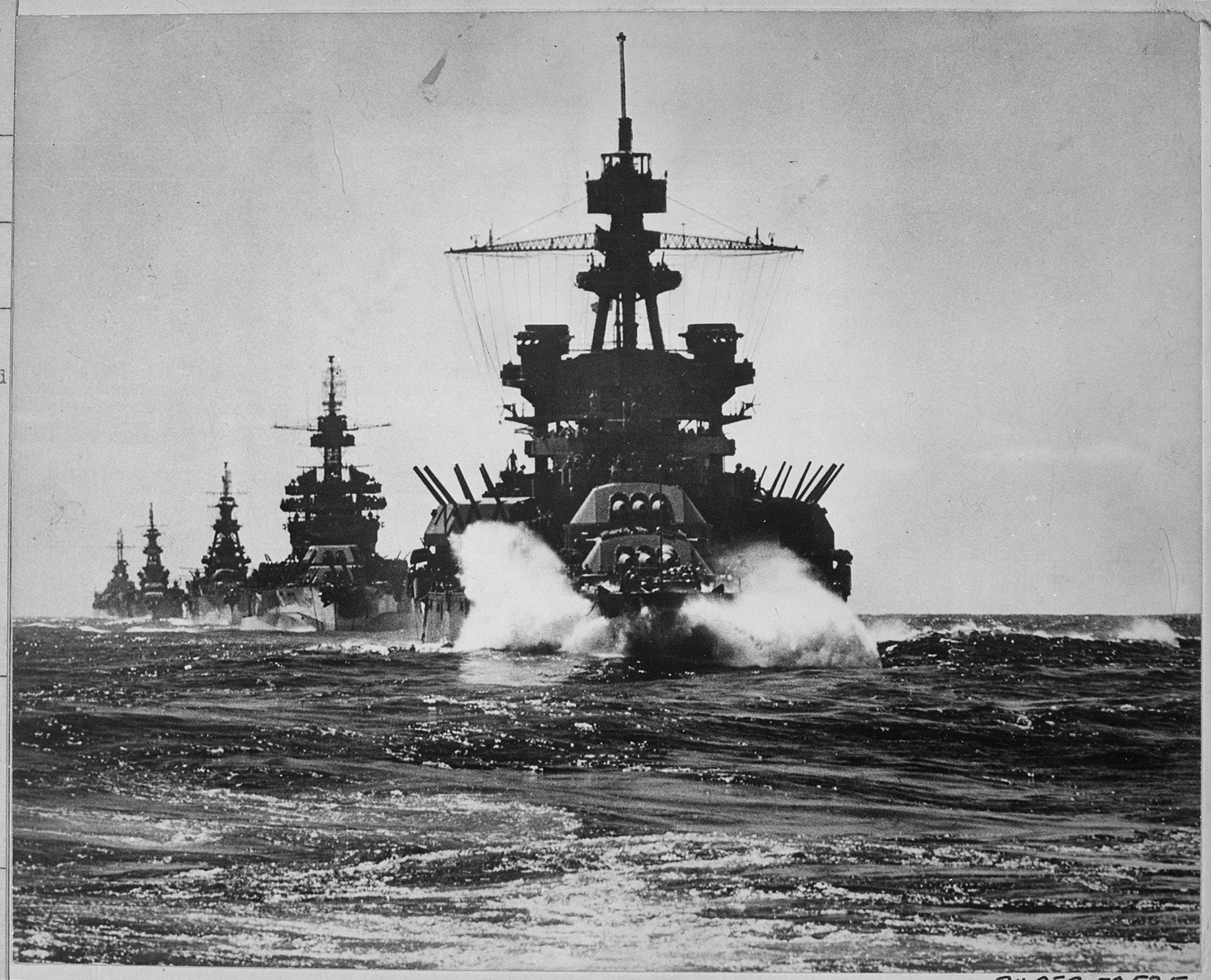
U.S. National Archives: USS PENNSYLVANIA and battleship of COLORADO class followed by three cruisers move in line into Lingayen Gulf preceding the landing on Luzon. Philippines, January 1945.
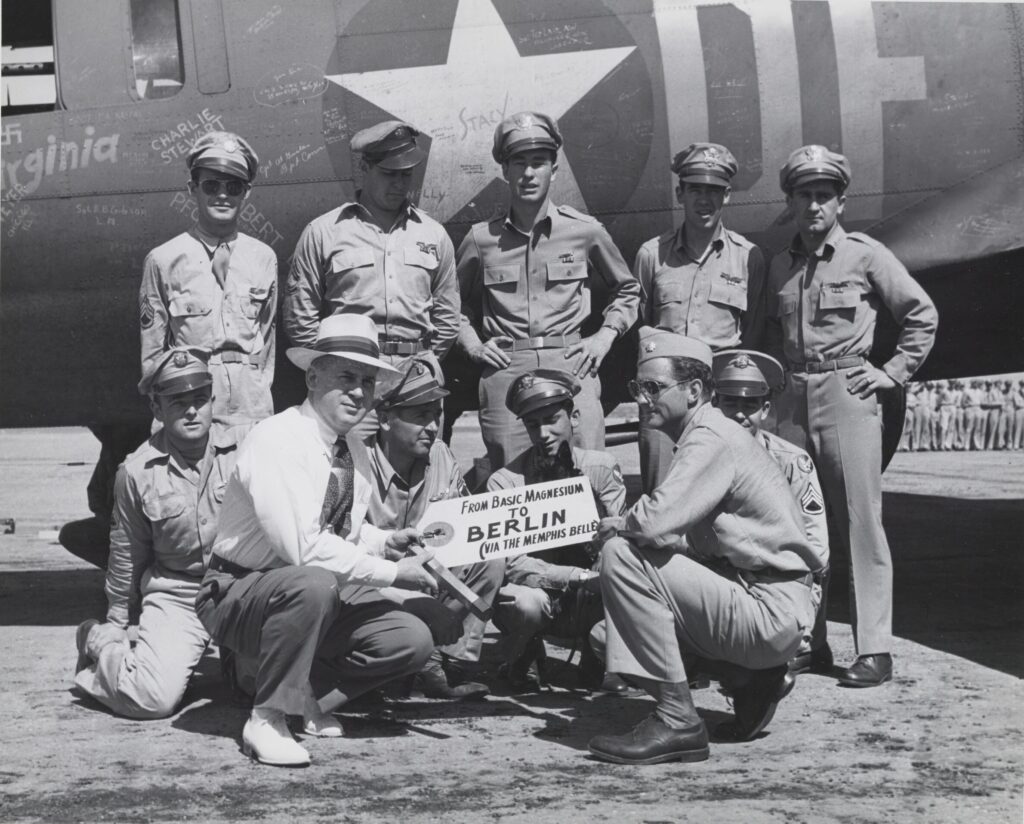
UNLV Library Special Archives: Crew of World War II bomber “Memphis Belle”: photographic print.