
By Eric C. Nystrom
Nevada was born of mining. The Comstock Lode and other rushes brought the population and industrial wealth that enabled the upstart territory to achieve an early statehood during the depths of the Civil War, in 1864. Indeed, there was little else. State Supreme Court Justice Thomas Hawley perfectly described this dynamic in an 1876 ruling: “Nature has denied to this state many of the advantages which other states possess, but, by way of compensation to her citizens, has placed at their doors the richest and most extensive silver deposits ever yet discovered.” Whether silver or gold or other metals, mining was the best of Nevada’s limited options.
A century later, in 1960, mining was no longer the linchpin of Nevada’s prosperity. Tourism and casino gambling, legalized in 1931, had become the new economic engine for the state. The heady days of the Tonopah and Goldfield boom of the early 1900s were half a century in the rear view. Gold mining as a whole in the United States was moribund, with the price firmly fixed at $35 per ounce by the government. In 1960, a total of 1.7 million ounces of gold was produced in the US – fully 1.3 million ounces less than domestic consumption.
South Dakota led all the states in production on the strength of the mighty Homestake Mine’s 554,000 ounces. A third of all gold came as the byproduct of mining for copper, including almost all of the output of the 2nd and 4th ranked producing states, Utah and Arizona. Nevada, ranked 8th among states in production that year, at least had one mine counted among the top ten gold producers, but it was the copper mine at Ely. An observer in 1960, reflecting on the long-ago glory years for Nevada’s gold mining industry, might well have imagined that good times might never occur again.
No one foresaw that the future held glittering riches of an inconceivable magnitude. In 2024, a down year, Nevada’s gold mines produced almost 3.5 million ounces of gold by themselves, and in 2025, the total production of the Carlin Trend exceeded a lifetime total of 100 million ounces – by consensus estimates, more than the California Gold Rush plus the Comstock Lode with room to spare. The story of that incredible transformation begins in 1960.
Nevada’s Carlin Trend Gold Rush – and here we include other “Carlin type” operations situated outside the geological phenomenon properly known as the Carlin Trend itself – was not quite an accident and not as simple as a bolt of genius insight. This wasn’t a single, lucky blunder like picking up a piece of rich ore to lob at a recalcitrant burro. Instead, it was a convergence of people, places, and technologies – some the product of hard professional work over decades, some strokes of vision, some thoughtful applications of technology from other fields, and a few fortunate breaks.
Such a complicated history could begin in many places, one point as good as another to begin. We might start with the insights of geologist Ralph Roberts, of the U.S. Geological Survey, whose examination of a geological structure known as the Roberts Thrust was revealed to the public in 1960. We could begin before then, in the 1930s and 1940s, when the existence of “microscopic gold” found in particles too small to see with the naked eye was first understood in a handful of mines in Nevada, including the Getchell and the Standard. Perhaps we begin with a gregarious geologist, John Livermore, who saw those mines for himself in the 1940s and read the sparse professional literature about them, and couldn’t help but think there must be others like that, somewhere. Upon hearing Roberts’ ideas, Livermore proposed to his employer, Newmont Mining, to go examine the Roberts Thrust in hopes of finding something good. In 1961, he got the OK, and took another young geologist, J. Alan Coope, with him.
This was an unusual move. Conventional wisdom in the mining industry at the time suggested that gold deposits near enough to the surface to mine with an open pit probably didn’t exist, and with gold at $35 per ounce, mass production mining underground could not make low grades of ore payable.
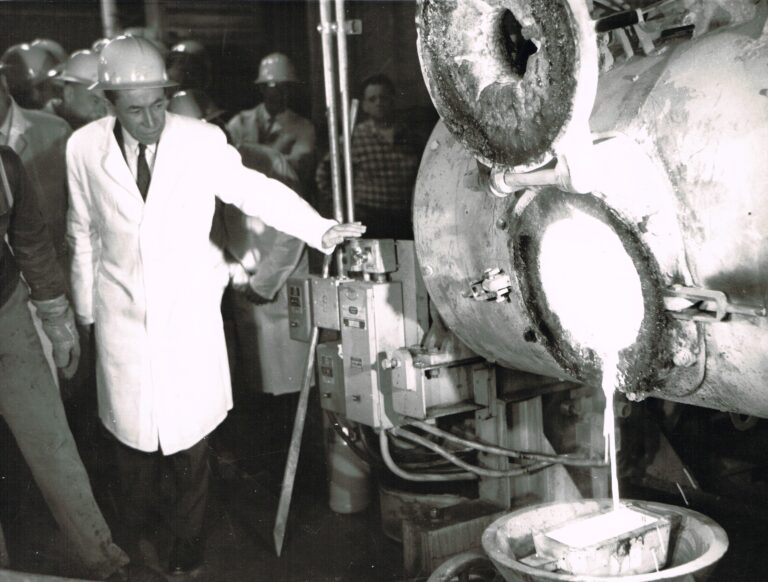
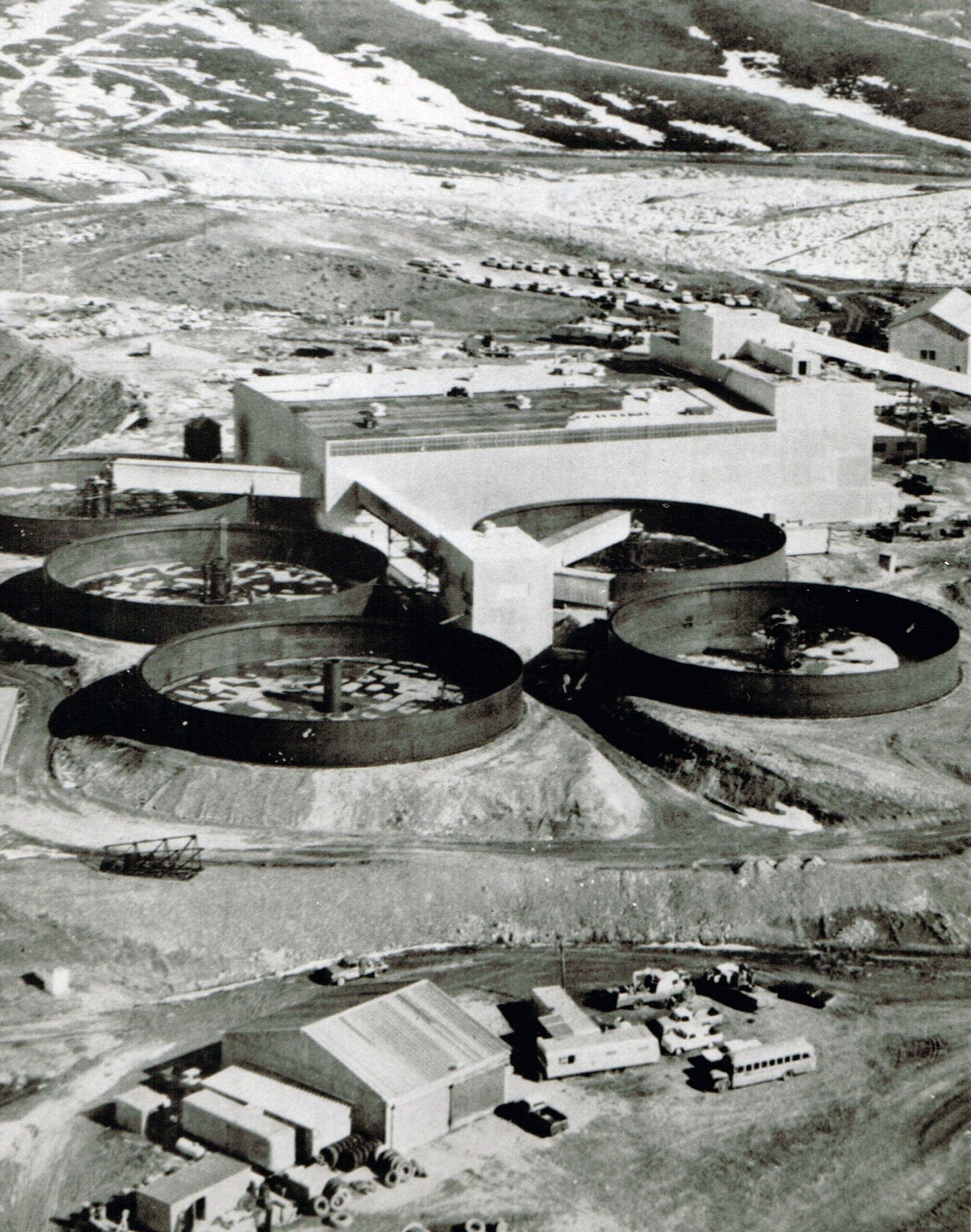
Careful, quiet sampling led them to Popovich Hill, near the site of some small earlier mines north of the railroad town of Carlin. The sample values held sufficient promise to justify staking sixteen claims. Once the claims were secure, they dug several trenches with a bulldozer, and found even better values lurking just below the surface. Newmont personnel returned the following spring, 1962, to further develop their information about the deposit through a drilling campaign and further exploration. What they found confirmed and boosted the values they had uncovered earlier. Newmont moved forward to acquire additional surrounding land, build a mill, and bring the Carlin Mine into production. The first gold bar was poured in the mill in May 1965.
Right from the beginning, Carlin was a large mine despite its low grade ore, with opening reserves of 11 million tons at .32 ounces of gold per ton. The total cost of the project up to the point of production was ten million dollars, a very modest figure by later standards. But the mining cost of such ore was only 4 or 5 dollars per ton, because it was located right at the surface, and the metallurgical treatment – using cyanide to extract the gold – was also an inexpensive, mature technology, so Carlin made money right from the start, even with gold at the low fixed price of 35 dollars per ounce.
Technological factors converged with the human factors. A key element was utilizing well-understood, mass-production mining technologies that had been developed into mature systems elsewhere. Many such technologies, including cheap drilling for exploration, using bulldozers and open pits, rubber-tired trackless haulage, and modern mills for fine grinding, had mostly come from the “porphyry” or low-grade copper mining sector, and a few, like the use of cyanide to extract the gold, had long been utilized by gold mines. By the end of the 1960s, US Bureau of Mines engineers worked together with the Carlin-type mine at Cortez to pilot another technology “mash-up.” They adapted the technology of leaching in a large heap pile, which had been used in copper and uranium, to the cyanide gold recovery process, and with some further cooperative development, produced the cyanide heap leach, which is arguably a defining technology of Carlin-type mining. The low cost of cyanide heap leach recovery systems, together with other mass production mining techniques, unlocked a system that could produce gold from extremely lean ores.
The convergence of technology, people, ideas, and rocks that started new low-grade gold mines at Carlin and Cortez soon were affected by factors originating well beyond northeastern Nevada. The US government removed itself from the fixed gold price in a series of steps in the late 1960s and early 1970s, allowing the price of gold to float with the market. Facing worldwide economic uncertainty in the late 1970s through the mid-1980s, the price of gold skyrocketed, pushing a wide variety of firms to explore northeastern Nevada in search of their own part of the Carlin Trend. Some of these searchers did indeed find more deposits, and with the right combination of luck, skill, finance, and geology, no minor combination of traits, these sometimes turned into productive mines. One of these was a property called Goldstrike, just northwest of Newmont’s Carlin properties, which was worked on a small scale beginning in 1976. In early 1987, it was purchased by American Barrick Resources, a Canadian firm, and developed into a world-class mine deposit, propelling Barrick’s entry into the Carlin Trend. Even existing firms, particularly Newmont, were pushed by takeover threats and new corporate leadership to more fully develop their gold mines in Nevada, leading to tremendous expansion in the mid-to-late 1980s. Worldwide attention, from financial to technical sectors, was then firmly fixed on northeastern Nevada’s invisible gold.
The mines of the Carlin Trend have resembled the low-grade copper mines in another crucial way. The vast extent of their deposits, and the heavy financial, regulatory, and technological burden that must be overcome before any gold can be refined, means that these modern mines must plan far, far into the future. They must have found huge orebodies, and have plans for mining them that can survive, in some cases, decades’ worth of ups and downs in demand. This long-term outlook creates something quite different than old time gold mines, with their boom town to ghost town trajectories. It creates relatively stable communities, where investments can, and must, be made in housing, roads, business, employee training, and all the rest. There still have been severe growing pains as the boom hits, and severe shocks as the price of gold fluctuated into periods of decline, but Carlin Trend communities have never threatened to become ghost towns.
It has now been more than six decades of steady production since the first gold bar was poured at the Carlin Mill in 1965. More than 90% of all the gold ever produced in Nevada, the state more reliant upon mining for its founding than any other, has come since 1965. In all, estimates suggest that 3.75% of all the gold ever mined in the world since the beginning of human history has come from Nevada. The convergence of geology, technology, people, finance, and luck that generated Nevada’s Carlin Trend gold rush has, in the process, created another significant byproduct: history.
Eric C. Nystrom is a Professor of History at the University of Nevada, Reno.
Photo Information:
Top Photo: Plato Malozemoff, president of Newmont pouring the first gold bar during dedication ceremony of Carlin Gold Mine – May 1965 – Elko Daily Free Press Collection – Photograph courtesy of the Northeastern Nevada Museum
Bottom Photo: Carlin Gold Cyanide Plant – April 1965 – Edna Patterson Collection – Photograph courtesy of the Northeastern Nevada Museum