
How Wartime Demand Shaped Nevada's Tungsten Industry
Geologists have known that tungsten is present in the Nevada since the mid-1860s. Found in scheelite or huebnerite veins, the mineral was not sought by prospectors during the 19th century. Its use was limited; as a result, the ore was essentially worthless. The development of steel alloys and the proliferation of their use made tungsten more valuable as Nevada went into the turn of the 20th century.
The first recorded production came from the lively Tungsten Mining District in White Pine County as vividly described by The White Pine News on January 11, 1900. Huebnerite was discovered at the base of Wheeler’s Peak in January 1899 by Charles W. Gaby, and the Tungsten Mining District of ten square miles was established. A fledgling town popped up about 12 miles south of Osceola and was named Tungsten.
This new production caught the attention of miners across the country, and in July 1901, the district was featured in New York Engineering and Mining. That same year, the U.S. Geological Service (USGS) published its first bulletin on tungsten production in Nevada and focused on the White Pine deposits.
As the price fluctuated and other deposits were located, Tungsten boomed and busted through the early years of the 20th century. In 1910, it was still large enough to stand as an election precinct in White Pine County with 24 voters, and a 50-ton concentrating mill was constructed.
But this first town of Tungsten was soon eclipsed by Tungstonia also in White Pine County and a later Tungsten in Pershing County. Tungstonia was located in White Pine’s Eagle Mining District, which dates back to 1859. Tungston was discovered in that district in 1910, and mills produced concentrates until at least 1916. Newspaper articles indicate that people were still living in Tungstonia in the 1940s, and production picked up on occasion during the 1950s and the 1960s.
In Pershing County, the town of Tungsten anchored the mining district in which the Nevada-Massachusetts Company was the largest corporate owner of tungsten mines and mills. By 1927, the company was the principal producer of tungsten in the country and would hold this position well into the 1950s. The accompanying town of Tungsten was the second largest community in Pershing County. According to a brief history penned by Donald Segerstrom whose family ran the company, Tungsten consisted of “a post office, general store, large single-men’s boarding house, elementary school, community hall, library, service station and more than 110 one-family dwellings.” The White Pine towns of Tungsten and Tungstonia were never as large as Pershing’s Tungsten. After the nearby mines and mills were closed in the late 1950s, Tungsten became “the youngest ghost town in Nevada,” according to the Reno Gazette-Journal. When the area was revived in 1981, according to the Reno newspaper, the town did not reappear. Instead, miners and their families lived in nearby Imlay or commuted from Winnemucca.
In the 20th century, the demand for tungsten was driven mostly by the country’s military activities during the two world wars and in eastern Asia. The primary domestic use was in incandescent lighting; tungsten is still found in light bulbs, although it is being rapidly replaced by LED. Advertisements for tungsten lights were common in Ely and Tonopah newspapers throughout the 1910s and could be found in the Reno Evening Gazette as late as May 1992. By the turn into the 21st century, Nevada newspapers carried ads for golf clubs strengthened with tungsten.
When demand was high, prices would rise and so would the number of tungsten discoveries. Nevada newspapers reported major discoveries near Goldfield in 1905, Round Mountain in 1907 and heralded it as the next big thing for Tonopah in 1907. Discoveries continued across the state. By 1988, the Nevada Bureau of Mines and Geology published a bulletin about the 375 deposits known to be in this state.
According to Frances Church Lincoln, Nevada’s primary mineral contributions during World War I were tungsten, antimony, manganese. During that time, Nevada produced 1,785 tons of tungsten from operations in Churchill, Mineral, Humboldt (Pershing), Nye, and White Pine Counties. Tungsten concentrates were valued at $3,650,485, roughly $88 million today.
According to annual production statistics compiled by USGS, Nevada produced about one-fourth of the country’s total. Most was used domestically and supplemented by international imports. According to USGS statistics, international production already far exceeded U.S. production by 1905, and since then, the U.S. contribution to world production has remained relatively minimal.
Small though it may be by international comparison, the U.S. production of tungsten has depended heavily on Nevada. By 1918, Nevada produced one-third of the country’s tungsten and was the second largest producer behind Colorado. At that point, most of Nevada’s ore came from the Eugene Mountains in what is now called Pershing County. (Pershing was the last county created by the Nevada Legislature. It was carved from Humboldt County in 1919.)
Prices crashed after 1918 but efforts to revitalize began in 1924 in Pershing, Lincoln, and Mineral Counties. By the 1930s, war in Europe was driving a demand that continued to grow through the World War II period and into the Korean War era. Nevada was the country’s major producer of tungsten. In particular, the Nevada-Massachusetts Company at Tungsten in Pershing County was the largest individual source of tungsten in the U.S. for many years.
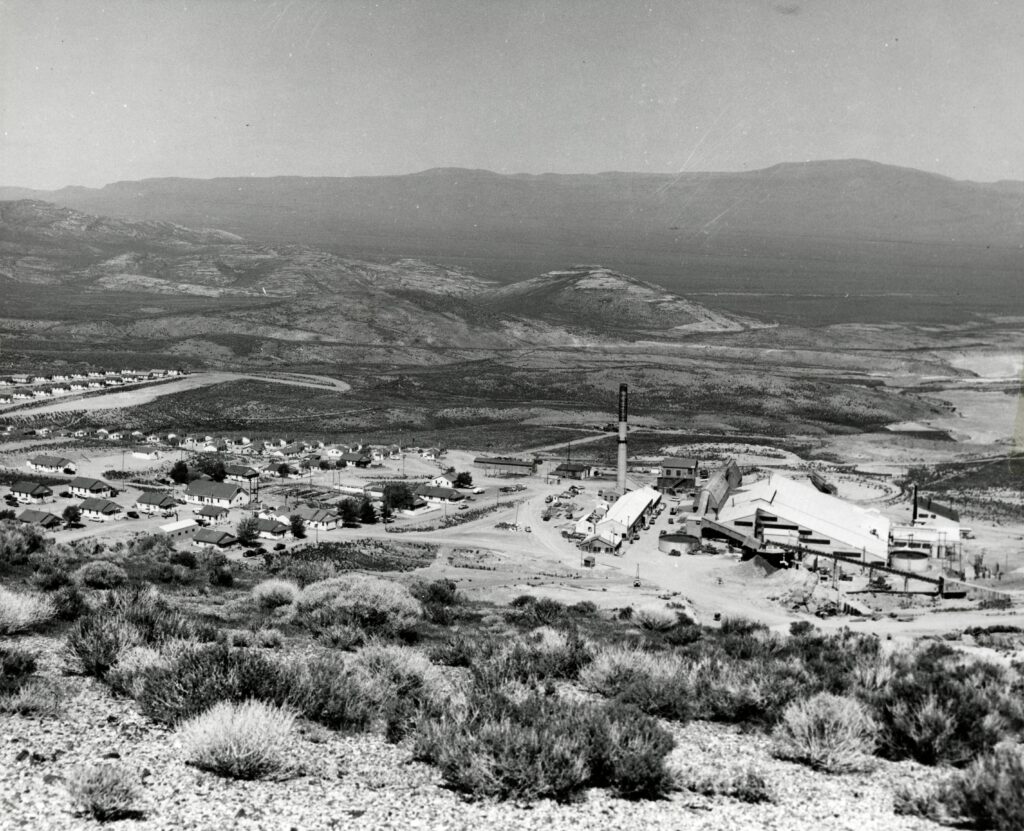
Nevada did not produce much gold or silver during World War II. In 1942, the Federal Government demanded that precious metal mines be closed across the country in an attempt to push mining efforts toward industrial minerals. In Humboldt County, the Getchell Mine near Golconda fortunately discovered a tungsten ore body next to its gold ore body; as a result, Getchell was the only Nevada mine that could commercially produce gold during World War II.
Nevada was the leading tungsten-producing state in the nation during the 1940s and again in the 1950s. In 1951, production increased 90 percent over the previous year mostly due to the adaptation of open-pit mining methods. Previously, scheelite and huebnerite veins were mined through underground tunnels and shafts. Government purchases also stimulated the demand for tungsten, and Nevada was the largest tungsten-producing state in the country from 1953 through 1955 with more than 30 operations. In 1954, Nevada’s mineral wealth came primarily from copper and tungsten production. Tungsten was just over $20 million, which is roughly $240 million today.
The last major tungsten mine was shut down in 1958, according to a 1964 publication. But never say “never again” in Nevada mining. Newspaper searches found numerous references to related mining activity after 1964. At the end of 1979, as Nevada entered a new decade, the President of the Nevada Mining Association, Robert Warren, announced Nevada’s latest “mining renaissance” with the expected opening of 15 new operations producing “tungsten, molybdenum, silver, gold, and uranium.”
Article contributed by Dana Bennett.
Photo Information:
View overlooking Getchell Mine and surrounding mountains. Photo taken between 1940-1959. Source: UNR Special Collections. Photographer: Irwin Fehr.