
"The Finest in the World": Nevada's Turquoise Legacy
The presence of turquoise mining pre-dates the 1864 establishment of the State of Nevada and even the 1850 gold discovery that precipitated the development of the Comstock Lode. According to Francis Church Lincoln who authored Nevada’s first mining history synthesis in 1923, evidence of indigenous mining activities was scattered across the state. As an example, he pointed to the stone hammers left at what became known as the Wood Mine in Clark County (p. 288). The Director of the Mackay School of Mines (1914-1923), Lincoln also noted that Clark County was the location of gold, silver, and turquoise mining activities by Spanish monks before 1848 when the area we now know as Nevada was ceded by Mexico to the United States.
Lincoln provided an overview of the early history of turquoise mining in his 1923 publication Mining Districts and Mineral Resources of Nevada. Forty-five years later, the Nevada Bureau of Mines (NBM) published Turquoise Deposits of Nevada, written by Frank R. Morrissey, a California reporter who became known for his turquoise expertise. Both publications serve as the primary sources of information for this overview.
Unlike most of Nevada’s metals and minerals, turquoise ore does not need to be milled or treated to separate the valuable gem from its rock host. Over time, Nevada’s turquoise mines have tended to be small “mom-and-pop” operations that were worked sporadically. In the mid-20th century, Nevada’s turquoise, especially from the Battle Mountain region, became prized for jewelry designers in Arizona and New Mexico, and Nevada was recognized as a unique and sought-after source of this semi-precious gemstone. By 1965, NBM characterized Nevada’s turquoise industry as having “produced perhaps $30 million in raw material and much more than this in value of finished gems.” (Morrisey, p. 5)
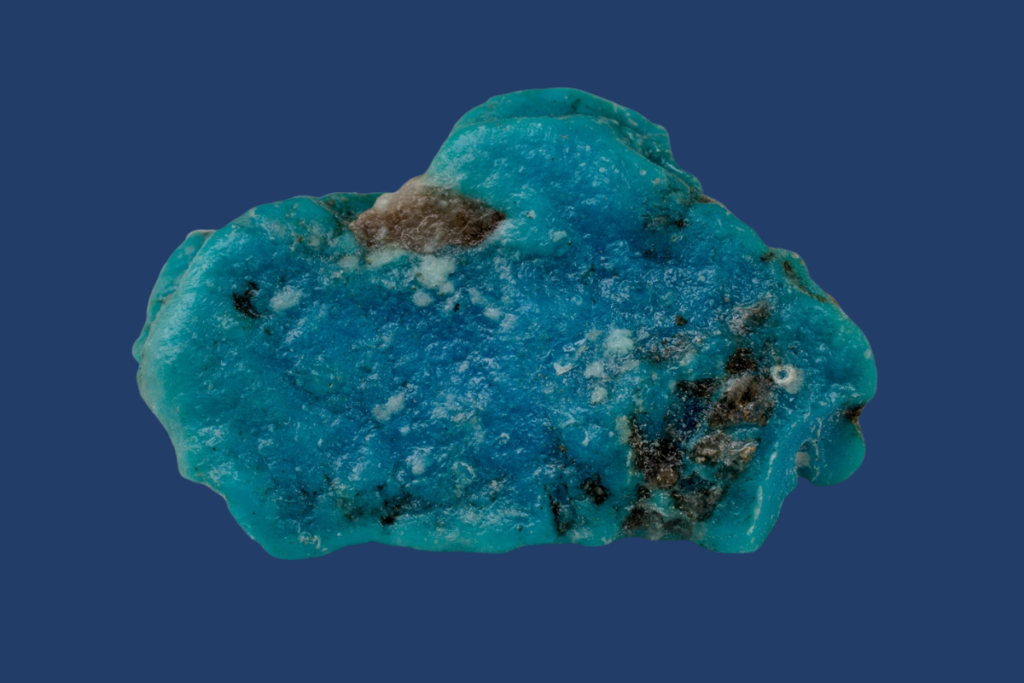
The earliest known turquoise production in Nevada (after statehood in 1864) was an 1875 discovery in the Columbus (later: Candelaria) Mining District in Mineral County. One particular nugget weighed 1.25 pounds and had a value of $1,000. But the district was primarily focused on silver production and did not record additional turquoise production until 1908.
Morrisey’s report lists nearly 100 mines of various sizes across eight counties that had sporadically produced turquoise between 1889 and 1965. The most significant producers were found in Lander and Nye Counties. He credited the Simmons mine in Clark County as the first producer in the state. The claims were staked by George Simmons in 1889 but the area clearly had been mined in the past. Abandoned tools, broken pottery, and the remains of dugouts provided evidence of that earlier activity. Followed by other owners, the Simmons claims were worked for decades and produced more than $1 million in turquoise.
In nearby Nye County, the Royston district was first discovered in 1902 and continues to produce turquoise today. The Otteson Family offers tours of their turquoise mines in this district and were the subject of a short-lived reality television series in 2019 titled “Turquoise Fever.” According to Morrissey, the major mine in the district was the Royal Blue, which “produced as much as 1,250 pounds of turquoise a month,” between 1911 and 1936, although the mine was not worked consistently during that time. Production was estimated to exceed $5 million.
Beginning in the 1930s, Lander County became the center of turquoise production in Nevada for nearly 40 years with several mines across the county. One of the oldest was the Fox Mine near the mouth of Cortez Canyon. The deposit was staked by Charles Schmidtlein in 1914 on property shown to his father by a Native American woman who worked in his household. Like the Simmons Mine, the Cortez area had been mined for its turquoise long before Europeans arrived. Morrissey estimated that the Fox Mine “has probably produced more turquoise than all the other mines in the State put together” – at least 500,000 pounds. For many years, its monthly production exceeded 2,000 pounds, much of which was of only fair quality. The Blue Gem Mine produced higher quality turquoise that has been sought by both artists and collectors.
In the mid-1950s, Battle Mountain focused its economic development efforts on the nearby turquoise producers with the tagline “Battle Mountain: Heart of the Turquoise Country.” In February 1954, the Nevada State Journal reported that 90 percent of the nation’s turquoise was mined in Nevada and most of that came from Lander County.
Most of Nevada’s gems have been small, but some astonishingly large pieces have been found over the years. According to Morrissey, a solid mass of turquoise of about 1,700 carats was found at the Fox Mine and sent to the Smithsonian Institute. As of 1968, the largest turquoise nodule ever found came from nearby Eureka County. On June 23, 1954, T.G. Edgar, J.M. Edgar, and Marvin Symes found a 150-pound specimen in their Number 8 Mine. According to a Gemini-assisted search, this Nevada discovery held the record for largest turquoise found in the United States until a 1982 discovery in Arkansas eclipsed it by 100 pounds.
In addition to being valued for its beauty, turquoise is also valued as an indicator element. Prospectors have noted that the presence of turquoise can also indicate the presence of copper or molybdenum.
Nevada’s role as the nation’s top producer of premium turquoise is undisputed. As noted in the 2014 article linked above, one of the best Navajo artists prefers to obtain his turquoise from Nevada mines. Over 100 years earlier, the Tiffanys of New York owned a turquoise mine in Southern Nevada. (Nevada State Journal, June 13, 1909) The famous jewelry designers had declared Nevada turquoise as the “finest in the world.” (Los Angeles Herald, July 27, 1908).
Article contributed by Dana Bennett.
Sources:
Lincoln, Francis Church. Mining Districts and Mineral Resources of Nevada, 1923, page 288.
Morrissey, Frank R. “Montezuma’s Slaves Took Riches in Nevada Long Years Before the Coming of White Men: Turquoise Is Important Link In History of State,” Nevada State Journal, January 24, 1954. Nearly a decade before the publication of the NBM report, Morrisey wrote this detailed and colorful article about the history of turquoise in Nevada.