
By Dana R. Bennett
Mining – the extraction of metals and minerals from the earth – has always been an important activity in this area of the Great Basin that now called Nevada. Before Europeans arrived in the 18th century, the people who lived in the Great Basin used gold and turquoise nuggets for jewelry, obsidian and stone for tools and weapons, and clay to fashion pots. Some of these minerals were used in trade as the residents of the Great Basin interacted with travelers from across the North American continent.
Around 1776, when the United States was forming on the eastern side of the continent, the first Europeans entered the Great Basin from the south. These prospectors were looking for silver, and they found it in what is now southern Nevada. They also mined turquoise and gold, leaving behind arrastras as evidence of their work. In the 1830s, when this area was still part of Mexico, miners worked in the part of southern Nevada that later developed into the Potosi mining district. In 1856, with the area now part of Utah, Mormons dug the first lode mine and built a smelter to extract thousands of pounds of lead.
The discovery of gold in 1849 on the western edge of the Great Basin in the Virginia Range launched Nevada’s mining industry, which has been important to the state’s economy ever since. Ten years later, that gold discovery was followed by the discovery of an immense silver ore deposit, and the Comstock Lode became globally famous.
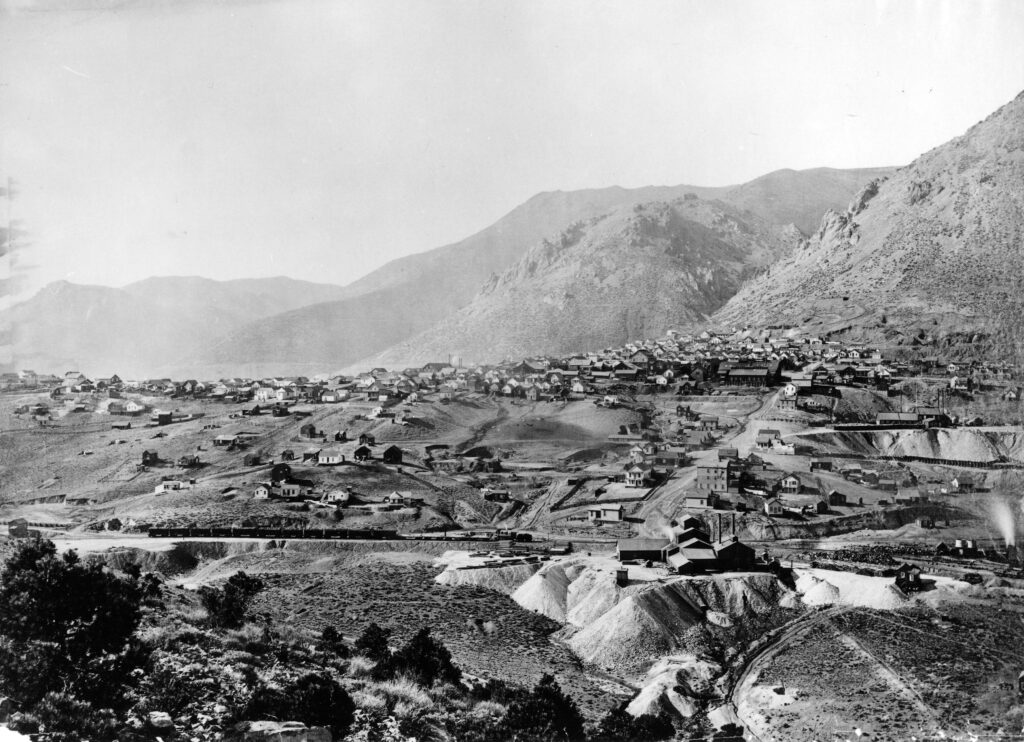
The booming Comstock Lode was one of the reasons that Nevada became a state in 1864. With more than 25,000 residents, Virginia City was the largest community in Nevada and the second largest in the American West, next to San Francisco where the first stock exchange was organized on the Pacific coast. Although it was in California, most of its stocks were Nevada mining companies. The Comstock’s mines and mills produced millions of dollars in gold and silver and also technology that changed the future of mining across the world. Innovations facilitated deeper mines and advanced milling processes.
While the Comstock’s impact on the development of Nevada cannot be underestimated, the mining industry was driving development in the rest of the state, too. In 1864, a discovery to the east near what became Eureka became the first great silver-lead district in the country and second only to the Comstock Lode in silver production in the 19th century. In north-central Nevada, an 1866 copper discovery launched the Battle Mountain mining district, which had attracted prospectors from Unionville. It is still mined today. Near the Utah border in 1865, gold and silver discoveries led to the establishment of the White Pine mining district. In the 20th century, this area would be the state’s primary copper producer.
In the last 30 years of the 19th century, 40 percent of the nation’s bullion came from Nevada. Although the focus was on gold and silver, Nevada also produced industrial minerals. Salt marshes in Churchill County were mined to support the Comstock’s mills and continue to produce salt for 21st century applications. In the 1870s, Nevada was the country’s primary producer of borax.
With few major new discoveries in the last part of the 19th century and the demonetization of silver in 1873, Nevada’s mines faced a serious downturn. They were certainly down but not out. New discoveries in southern Nevada at what became known as Delamar and Searchlight were promising producers.
Tonopah is credited with the resurrection of Nevada’s gold and silver mining industry at the turn into the 20th century, and exciting discoveries at Goldfield in 1903 launched prospectors across the state. With motorized vehicles, exploration could take place faster and in more areas. New districts popped up everywhere: Manhattan and Fairview in 1905; Wonder and Round Mountain in 1906; Rawhide, Midas, Seven Troughs, and National in 1907; and Jarbidge in 1909, all yielded gold, silver, lead, and zinc.
Copper production also increased, especially after the first large-scale smelter was constructed at McGill. The Yerington and Ely Districts were the most productive early in the 20th century. Nevada’s first lode mine, Potosi near Las Vegas, re-opened in 1906; during World War I (1914-1918), it was the largest zinc mine in Nevada.
The Great War stoked Nevada’s mineral production. The output of silver and copper rose, and the production of industrial minerals became economically significant for the first time. Nonmetallic elements were known to be present but other countries had larger deposits and less expensive costs. The U.S. imported much of its industrial mineral supply until the war disrupted global trade. Nevada’s minerals took on new importance for the country, and Nevada mines produced tungsten, manganese, antimony, molybdenum, uranium, vanadium, zinc, and lead.
The 1918 Armistice reinstated global trade and depressed mineral prices, and Nevada’s mining industry faced a downturn going into the 1920s. By mid-decade, however, recovery was initiated with high-grade gold discoveries in Esmeralda, Lincoln, Mineral, and Pershing Counties. An increasing demand for insecticides drove a boom in arsenic production. Nevada’s major mineral products by 1929 were gold, silver, copper, lead, quicksilver, and zinc.
The Great Depression, which began with the stock market crash in October 1929, also punched Nevada’s mining industry in the gut. In 1932, the value of Nevada’s mineral production was the lowest it had been since the dark days of the 1890s. In addition to depressed mineral prices, Nevada’s mining industry was stunted by a lack of investment capital.
By 1936, however, an increase in the price of gold drove renewed production in Clark, Elko, and Esmeralda Counties. Copper production was so high in White Pine County that the region yielded the state’s largest portion of mineral wealth in 1935. The discovery of a new gold deposit in Humboldt County led to the development of the Getchell Mine, and global tensions escalated the demand for industrial minerals. In 1939, Nevada’s mineral production rose 30 percent over the previous year.
Like the Great War in the 1910s, World War II demanded much of Nevada’s mineral storehouses. Copper production rose 44 percent, and mercury production increased an astonishing 750 percent from 1939 to 1940. Fluorspar and tungsten mines flourished, and Nevada was soon the second largest producer of antimony in the country.
In 1942, the Federal Government shuttered all gold mines, hoping to force the industry’s attention on producing non-precious metals and minerals. Mines cannot be opened and closed like retail candy shops, however, and the effect in Nevada was to destroy the gold mining industry as mines collapsed or filled with water. In 1944, the value of industrial minerals exceeded the value of precious metal production for the first time in Nevada’s history. The only major gold mine that continued to produce was Getchell because it also had a large tungsten deposit. Nevada’s gold mining industry did not fully recover until the development of the Carlin Trend in the mid-1960s.
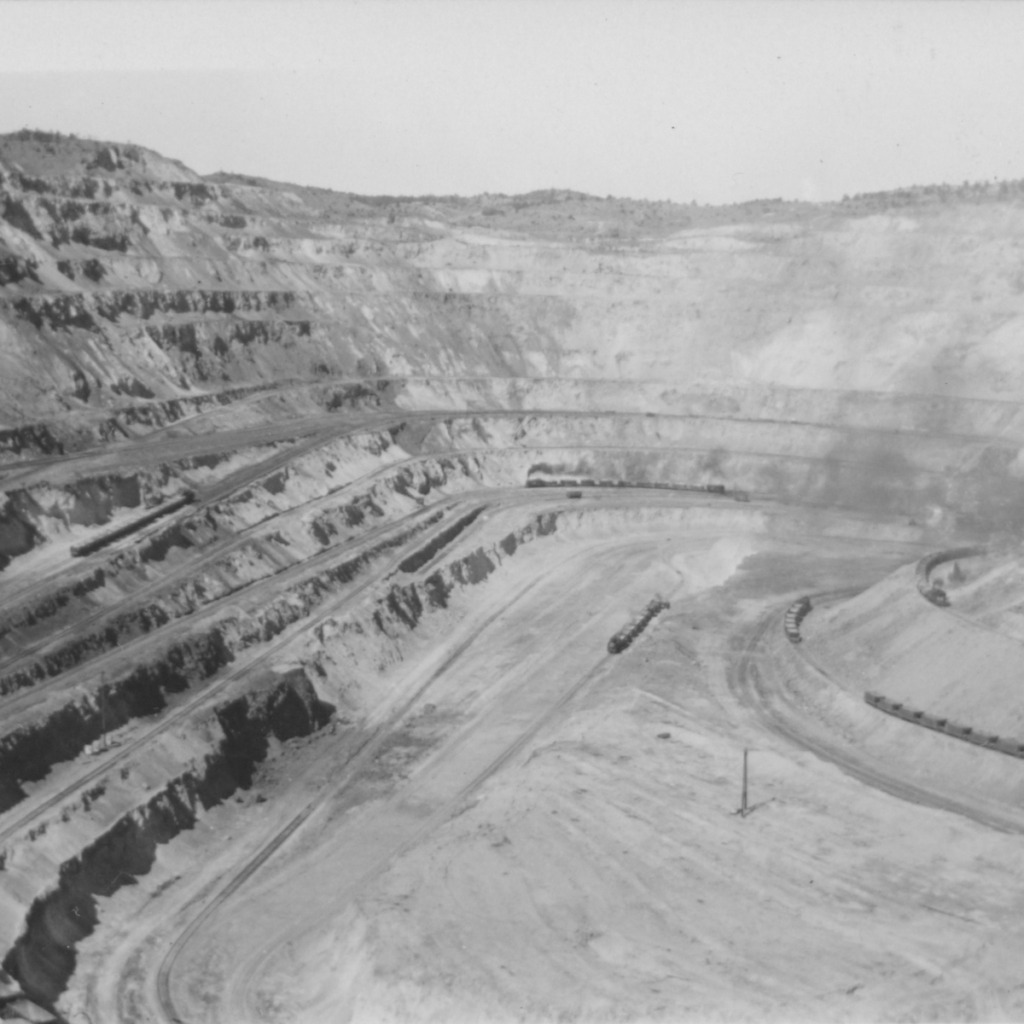
Nevada became primarily an industrial minerals producer for the first time in its history. Manganese and brucite came out of Clark and Nye Counties. During the 1940s and 1950s, Nevada was one of the leading producers of tungsten, mercury, and antimony. Combined with increased output in copper, diatomite, and zinc, Nevada’s mining industry prospered in the 1940s and 1950s, even without gold. The adaptation of large-scale, rubber-wheeled construction equipment replaced the use of rail-bound ore carts, leading to an expansion of surface mining. This period also saw a rare expansion of iron ore production and the extraction of petroleum. By 1953, the value of Nevada’s mineral output had reached new heights.
Well into the 1960s, the production of copper, tungsten, manganese, and iron dominated the state’s output. Two notable developments were the shift to the open-pit production of gold and the application of the heap-leach processing system, which had been developed at the University of Nevada.
The first gold bar from the Carlin Trend was poured in 1965, changing Nevada’s mining industry yet again. By 1986, when Elko announced its first mine expo, Nevada was ranked first in the nation for the production of gold and barite, most of which came from within a driving radius of Elko. The domestic barite industry was struggling against intense foreign competition, but gold production was expanding. Nevada had been the country’s number one producer of gold in the U.S. since 1979, a title it has yet to relinquish. Nevada’s gold production peaked around 1999 and has been steadily declining. Production in 2023 was the lowest it had been since 1988 yet more than three times the amount produced just before the expo first opened.
The extraordinary increase in gold production that began in 1965 has dwarfed the value of silver and industrial minerals in Nevada and often dominated news about the industry. Yet Nevada’s mining industry continues to be diverse. For more than 175 years, Nevada has steadily produced precious metals plus a smorgasbord of industrial minerals from every county and every corner of the state.
Dana Bennett has a PhD in history and previously served as the President of the Nevada Mining Association. To produce this very brief summary, she relied on publications from the Nevada Bureau of Mines and Geology and data from the Nevada Division of Minerals.
Photo information:
Top Photo: a panoramic of Virginia City in the 1860s or 1870s
Bottom Photo: Photograph of open pit mine, Ruth, Nevada, 1934 – Elbert Edwards Photograph Collection. PH-00214. Special Collections and Archives, University Libraries, University of Nevada, Las Vegas. Las Vegas, Nevada