
Nevada Gypsum and the Building of the West
Gypsum appears in Nevada’s written record early, but it took decades before it became an industry. Reports of gypsum deposits began circulating in local newspapers in 1864, usually in conjunction with other activities such as the construction of the Sutro Tunnel in the 1870s. As The Pioche Record observed in 1873, however, “[w]e cannot see any immediate source of wealth in these [gypsum] deposits; in the future, however, they may become valuable.”
That future arrived a few years later. A large deposit near Mound House in Lyon County began producing gypsum—some for construction, but more for fertilizer. Deposits in Elko and Humboldt Counties began to show promise; in 1887, the Yerington newspaper explained that “[a] gypsum mine, conveniently located, is of more value to a poor man than a silver mine in a remote district.” In 1899, former Nevada Governor Jewett Adams acquired the Mound House claims and repurposed the Mexican mill near Empire on the Carson River. More importantly, he addressed the transportation issues that had been hampering Nevada’s gypsum industry by pulverizing gypsum into a shippable powder and negotiating with railroad shippers for better terms.
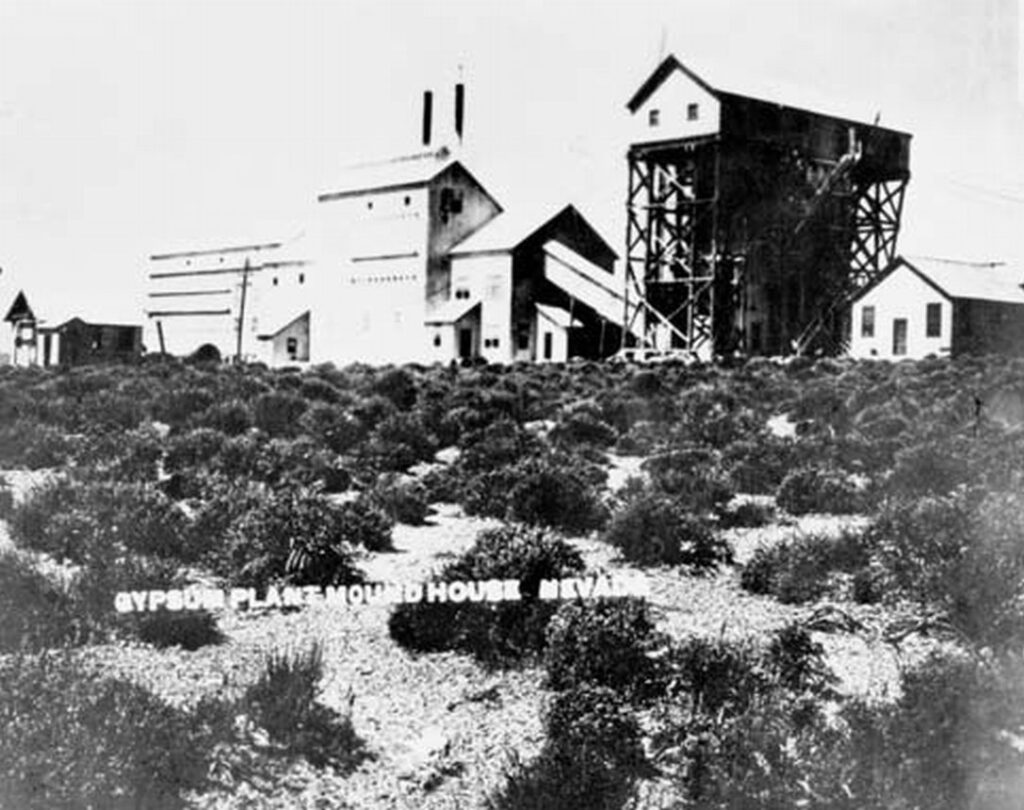
Adams kept expanding the business and was in an excellent position to provide critical building materials to San Francisco after the 1906 devastating earthquake and fire. Among the destroyed facilities were plants that manufactured gypsum products. Instead of rebuilding in California, new plants were constructed in Nevada, including one at Mound House. These new plants and San Francisco’s tremendous demand for construction materials combined to drive growth at Mound House. Investors joined Adams to form the Nevada Gypsum Company in 1908, and mining engineer (and future Governor) Emmet Boyle was engaged to design and construct a much larger mill and aerial tramway in 1909. A small town developed around the new mill. By 1911, the company’s products were being shipped to Seattle and Honolulu in addition to San Francisco and Oakland.
In 1912, the company was sold to the Pacific Portland Cement Company of San Francisco, which continued expansions, and within a year, the operation was one of Nevada’s largest manufacturers. By 1922, however, the Pacific Portland Cement Company began phasing out of Mound House in favor of developing a large gypsum deposit near Gerlach in Washoe County. A mill was built, and a spur line connected the mill to the main railroad. An aerial tramway linked the mill to its quarry, and a company town called Empire was established. When the Empire operations began, the mill at Mound House was dismantled, and mining at that location ceased until the mid-1940s. Art Wilson purchased the claims and continued mining gypsum until he sold the company in 2015.
The Pacific Portland company operated the Empire mine and mill until they were sold to the U.S. Gypsum Company, the country’s largest gypsum producer, in 1948. The sale also included a hotel, homes for married employees, and the electric plant for the nearby town of Empire. By 1950, more than 200 people lived and worked in Empire. Its closure in 2011 was dramatized in Nomadland, a movie that won the Golden Globe for Best Picture in 2021. The Empire operation reopened on a much smaller scale in 2016.
In southern Nevada, a large gypsum deposit was located in 1905 south of Las Vegas near the rail shipping point of Arden, and a large mill was built to serve fast-growing construction markets in Southern California. The work was not without risk: in September 1908, a premature quarry explosion killed one worker and injured others. The Arden Plaster Company covered care for the injured and funeral expenses for the deceased. Four years later, fire destroyed the company’s plant; it was soon rebuilt. In 1919, the Arden Plaster Company was purchased by the U.S. Gypsum Company. By 1923, the Arden mine included underground workings in addition to a pit that was mined with steam shovels. The Arden deposit was mined out by 1931, and the operation abandoned. By the 21st century, Las Vegas housing developments had encroached on the old mine, and the site was finally secured by the Nevada Division of Minerals in 2018.
In 1925, the Blue Diamond Corporation began mining a deposit west of Las Vegas and north of Arden. Like its neighbor, mining occurred both underground and on the surface. In 1942, the processing plant was relocated from southern California, and a company town known as Blue Diamond was built to house the employees and their families. In the 1950s, more than 300 employees worked at the Blue Diamond operation. Since 2003, the property owner has attempted to convert the industrial site into a residential development, but local opposition has delayed that action because the site is near the Red Rocks Natural Conservation Area.
The Pabco surface mine and wallboard plant began operation in 1952 and continues today east of Las Vegas. Of the 11 gypsum operations in Nevada in 2024, seven are in Clark County. Among the others are continuing operations in Lyon and Washoe Counties.
Article contributed by Dana Bennett.
Photo Information:
A gypsum plant in Mound House. The “mound” in Mound House refers to natural deposits of gypsum in the area. Source: Western Nevada Historic Collection through the Nevada Appeal.