
How the Cold War Sparked Nevada's Search for Uranium
In 1924, the Director of Nevada’s Mackay School of Mines wrote that uranium was known to be in Clark and Lincoln Counties, but no one had yet commercially mined those deposits. At the time, no market existed for the element.
With the development and testing of atomic weapons after World War II, the demand for uranium skyrocketed. Prospectors fanned across Nevada and the rest of the country, looking for uranium deposits. The U.S. Atomic Energy Commission officially asked that all prospectors carry Geiger counters “and keep an eye out constantly for uranium.” In addition, the U.S. government guaranteed uranium’s price “with bonuses for big new discoveries.”
A few uranium deposits, mostly low-grade, were found in Nevada, such as a 1950 discovery near Midas. The find was so exciting to Elko that the ore samples were displayed in the window of the local newspaper’s downtown office. Deposits were also located near Mountain City and in Washoe, Humboldt, and Churchill Counties.
In 1953, a silver discovery south of Austin was developed into the Apex Mine (also known as the Early Day Mine). Nevada’s biggest producer of uranium by far, the Apex produced uranium as a byproduct until about 1966. In all, Nevada’s production of uranium was quite small – only about 26,000 tons – and paled in comparison to the production from Colorado and Wyoming.
A year later, a new mining company promoted its uranium development near McDermitt on the Nevada-Oregon border. The deposit had been examined by the Atomic Energy Commission and appeared to be high-grade. Despite an initial flurry of construction activity, the mine did not materialize.
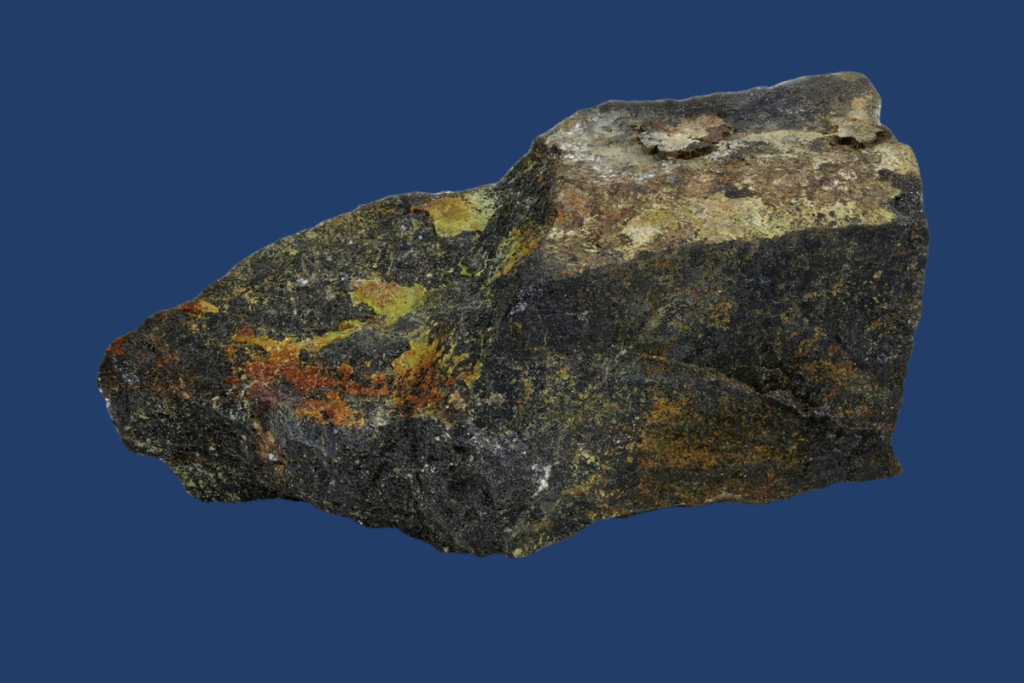
Perhaps further development of that mine and other Nevada deposits was stunted by the Atomic Energy Commission’s later determination that it would limit the amount it would buy. Exploration between 1948 and 1958 had been successful, especially in other states, and it appeared that additional uranium mining would not be necessary. The Nevada Bureau of Mines estimated in 1964 that Nevada had “several tens of thousands of tons which the U.S. Atomic Energy Commission considers available (minable)… and a slightly smaller amount which is considered unavailable, because of tenor, size, location, or character of deposit.”
Although uranium mining has continued in other states, very little uranium was produced from Nevada mines after 1965, despite several attempts to begin mining.
At the end of 1979, the President of the Nevada Mining Association, Robert Warren, announced Nevada’s latest “mining renaissance” with the expected opening of 15 new operations producing “tungsten, molybdenum, silver, gold, and uranium.” One of those was anticipated to be Chevron Resources’ uranium mining operation near McDermitt. The company did not construct a mine, but its exploration efforts in the early 1980s led to the identification of a large lithium deposit.
Despite much enthusiasm, the Nevada mining industry has not historically produced much uranium. Past production (or lack thereof) does not predict future production with much accuracy, however. The lithium deposit near McDermitt is a tremendous example. The Mackay Director did not mention the existence of lithium at all in his 1924 exhaustive compendium of Nevada minerals and mining districts. In 1964, the Bureau of Mines reported that Nevada had, at best, a “meager source” of lithium, but acknowledged that lithium deposits were then unknown because no one had a reason to look for them.
Article contributed by Dana Bennett.
SOURCES:
“Carry Geiger Counter, U.S. Urges Miners,” Nevada State Journal, April 20, 1950.
Lincoln, Francis Church. Mining Districts and Mineral Resources of Nevada. Reno: Nevada Newsletter Publishing Company, 1923. Reprinted in 1982 by Nevada Publications.
Lincoln, Francis Church and Robert C. Horton. Outline of Nevada Mining History. Nevada Bureau of Mines Report No. 7. Reno: Mackay School of Mines, 1964.
Nevada Bureau of Mines, Mineral and Water Resources of Nevada, Bulletin 65. Reno: Mackay School of Mines, 1964.
Rice, John. “Nevada’s mining renaissance,” Reno Evening Gazette, December 8, 1979.
“Uranium Ore of Low Grade Is Found At Midas,” Elko Daily Free Press, May 8, 1950.